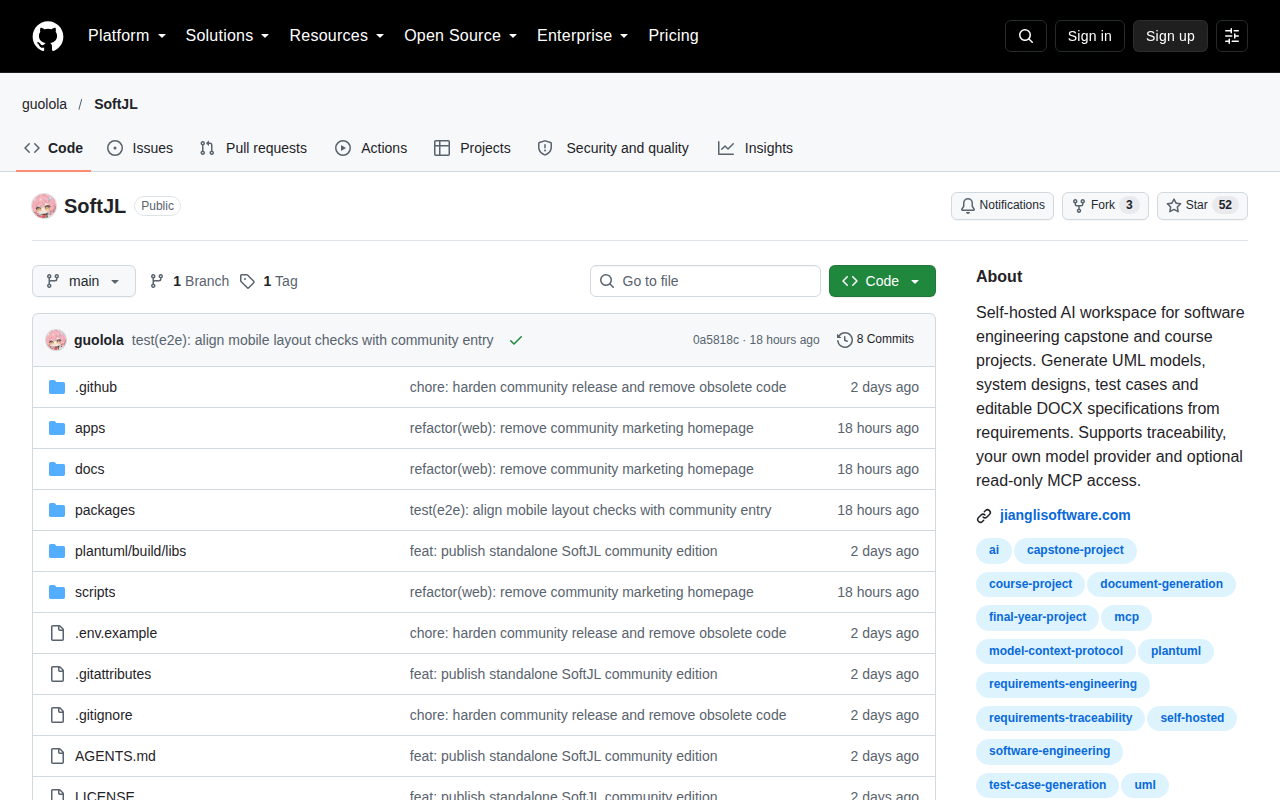
What is SoftJL?
A self-hosted AI workspace for software-engineering course and capstone projects: give it requirements, and it generates UML models, system designs, test cases, and editable DOC specifications — with traceability between requirements and artifacts. It’s built for the academic SE workflow where the deliverable is a documentation package, not just code.
Who uses it and why
- CS students working on capstone/course projects who need the full artifact set (UML + design doc + test plan + spec) on schedule.
- Instructors who want a reproducible pipeline for course documentation.
- Small teams doing lightweight SE documentation without a full Enterprise Architecture tool.
Key capabilities
- Requirements → artifacts — UML, system design, test cases, DOC specs.
- Traceability — requirements map to design elements and tests.
- Editable DOC output — not locked in a proprietary tool.
- Self-hosted — runs on your infrastructure.
Pricing
Free, open source.
China accessibility
ok — self-hosted; no external dependency in the core loop.
Limitations
- Early-stage (63 stars); output quality depends on the LLM configured.
- Academic focus — for professional-grade architecture you’d use heavier tooling.
- Traceability is only as good as the requirement granularity you provide.
Alternatives
- PlantUML — UML from text, no AI.
- draw.io — manual diagramming.
- Confluence + Jira — the commercial SE documentation stack.
Best for
SE course/capstone students who need a one-stop AI pipeline from requirements to a complete, traceable documentation package.
No comments yet. Be the first to share.